YOUR CART
- No products in the cart.
Subtotal:
$0.00
BEST SELLING PRODUCTS
Across industrial, commercial, and utility sectors, double-wall aboveground storage tanks (ASTs) remain a trusted way to store fuels, chemicals, and other regulated liquids. The second wall provides secondary containment — but containment only works as protection if someone knows when the first wall has failed. That knowledge lives in the interstitial space, the gap between the two walls.
A breach in the primary wall sends product into that space before it goes anywhere else. It is the earliest and clearest warning a double-wall tank can give. Without a way to see it, the first sign of failure can go unnoticed until the secondary wall is carrying the full load on its own.
The Krueger Sentry Gauge Type K leak detection gauge makes that warning visible at the top of the tank — mechanically, with no power, no wiring, and nothing to calibrate.
In the United States, EPA release-detection requirements under 40 CFR Part 280 list interstitial monitoring among the approved methods for secondarily contained underground storage tank systems. Many state and local rules apply similar thinking to aboveground tanks, often alongside codes such as NFPA 30 where they have been adopted. The specifics vary by jurisdiction, but the principle does not: liquid in the interstitial space is a signal to act on, and it only helps if someone is watching for it.
When a primary wall leaks, product collects in the interstice. Left unaddressed, it can attack the secondary wall or find its way out through penetrations and fittings, turning a contained leak into a release — along with the cleanup, downtime, and regulatory exposure that follow.
Your takeaway: Put interstitial checks on a formal schedule. Frameworks governing underground systems commonly require interstitial monitors to be checked at least every 30 days, and a monthly check is sound practice on aboveground double-wall tanks whether or not a rule requires it. Confirm the requirement that applies to your tank with your state or local authority.
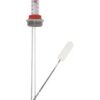
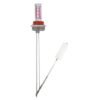
The Type K is a vertical, float-type leak monitor. It threads into a fitting at the top of the interstitial space, or into an external monitoring pipe, and its float sits at the bottom of that space.
That is the whole reading. The indicator is not calibrated to a level; it shows leak or no leak. There is no scale to interpret, which is the point — anyone walking past the tank can see the answer.
Because the gauge responds to any liquid collecting in the interstitial space, an indication should always be investigated rather than explained away. The job of the Type K is to tell you, early and unmistakably, that a space which should be dry no longer is.
Your takeaway: Confirm that the gauge’s materials suit the stored product and the service environment. Standard construction uses aluminum rods, an aluminum bushing, and a plastic calibration. Plastic and stainless steel alternatives are available, though custom materials carry smaller size limits.
A leak monitor that depends on power or a signal can stop reporting without announcing it. The Type K has no such failure mode: what it shows is what is in the interstitial space. For facilities handling regulated liquids, that makes it a straightforward component to build into an asset integrity program — and a straightforward one to defend in an inspection record.
Your takeaway: Add a visual check of every Type K to your routine tank inspection. Record the result each time, including “no indication,” and align the frequency with EPA requirements, applicable state AST rules, and codes such as NFPA 30 where adopted.
Contact us today to discuss your needs or request a quote. Our team is ready to help you find the best solutions for your storage systems.
Choosing the right tank gauge is about more than just checking a level; it is about ensuring uptime, safety, and long-term value. Whether you are managing a chemical plant, a fleet of delivery trucks, or a residential heating system, the hardware you choose today dictates your maintenance costs for years to come.
To help our partners make the most informed decisions, Krueger Sentry Gauge is proud to announce the release of our latest resource: “Mechanical vs. Digital Liquid-Level Gauges: A Practical Selection Guide for Aboveground Storage Tanks.”
With over 80 years of experience and 4 million gauges in the field, we have seen how the wrong technology can lead to unnecessary failures. While digital systems offer remote monitoring benefits, they often introduce complexity and power dependencies that mechanical systems simply do not have. This eBook breaks down the “Rule of Thumb” for modern tank management: Use a mechanical gauge as your primary visual indicator, then add digital only where it delivers clear operational value.
Download the free eBook today and learn why 100% American-made mechanical gauges remain the industry standard for reliability.
Download the eBook Now
The guide covers our three flagship solutions in detail:
At Krueger Sentry Gauge, we do not just sell hardware; we provide peace of mind. This guide is our way of sharing nearly a century of expertise with the people who keep our industries running.
Interstitial monitoring plays a crucial role in tank safety and compliance. This leak detection method guarantees that storage systems adhere to regulatory standards and tank safety requirements. Interstitial monitoring can also protect the environment by controlling leaks and ensuring safe operations in industrial settings.
Delve into what interstitial monitoring is and its role in leak detection and prevention. You’ll also find information on the types of monitoring gauges and systems available at Krueger.
Interstitial monitoring is a leak detection method used in double-walled piping systems. These systems feature an inner and outer pipe with interstitial space between them. Sensors or monitoring devices continuously check for the presence of leaked substances in the area. Piping systems are designed to contain any leaked fuel in the area between the two walls.
The primary goal of interstitial monitoring is to detect leaks earlier so potential issues can be addressed before they become major problems. This proactive approach minimizes the risk of costly clean-ups and environmental damage. Interstitial monitoring is commonly used in underground storage tanks (USTs) and above-ground storage tanks (ASTs), providing a reliable detection method that maintains the integrity of storage systems and protects the environment.
Interstitial monitoring is a critical component of comprehensive automatic tank gauging systems (ATGS). Federal UST regulations require that the monitoring system in place must reliably detect any leakage coming through the inner wall of the piping system. Interstitial monitoring quickly and consistently detects even the smallest leaks, preventing significant damage and costly repairs.
Monitors can vary in complexity, ranging from simple dipsticks to advanced automated systems:
At Krueger Sentry Gauge, we offer a range of interstitial monitoring gauges and systems designed for reliability and accuracy:
Our Type K leak detection gauge is a dependable vertical monitor for double-walled above-ground containment tanks (ASTs). This gauge detects leaks within the annular/interstitial space.
The Type K monitor is ideal for facilities looking for a straightforward, reliable solution to leak detection. The robust mechanical design of these leak detection gauges promotes durability, dependable monitoring, and easy installation and repairs.
The LRDP is an advanced, automatic, computer-controlled system for bulk fuel ASTs. It uses a mass-based measurement technique to detect small leaks. The system includes a closed reference tube filled to the same level as the tank, with a differential pressure (DP) sensor to detect any discrepancies.
The LRDP’s sophisticated design offers continuous, accurate monitoring, making it a valuable tool for large-scale fuel storage facilities. This method offers high precision and can be customized to meet your application’s needs. Temperature sensors can also be attached to account for diurnal expansion and contraction with regular testing to minimize the effects of temperature variations.
Investing in interstitial monitoring systems from Krueger Sentry Gauge means prioritizing safety, compliance, and environmental protection. We have been a leading manufacturer of high-quality tank gauges for nearly a century.
Our continued commitment to excellence is evident in the over four million liquid-level gauges we’ve produced, catering to various industries and applications. Our gauges and components are all made in the USA and comply with the Buy American Act.
Contact us today to discuss your needs or request a quote. Our team is ready to help you find the best solutions for your storage systems.
Uncontrolled releases from Aboveground Storage Tanks (ASTs) impose severe financial and environmental penalties on operators. Facility managers must implement robust spill prevention measures to safeguard public safety and maintain operational integrity. A single, catastrophic overfill event can generate millions in cleanup costs and trigger massive federal fines. The reliable Overfill Alert Gauge (Type OF) constitutes a non-negotiable component of any credible spill prevention strategy.
Regulatory bodies, including the Environmental Protection Agency (EPA), strictly enforce compliance with the Spill Prevention, Control, and Countermeasure (SPCC) rule. This federal mandate requires owners or operators of bulk storage facilities to install reliable warning systems and proper operating procedures. Non-compliance often results in fines reaching tens of thousands of dollars per day, significantly impacting a company’s balance sheet. Industry best practices, specifically outlined in American Petroleum Institute (API) Recommended Practice 2350, further define the accepted protocols for preventing tank overfills in petroleum facilities. This standard dictates that bulk liquid terminal operators should employ a three-tier defense system, mandating reliable high-level alarms to initiate proper emergency response procedures. Facility engineers must determine alarm set points based on tank category, rate of filling, ullage, etc., per API 2350.
Your Takeaway: Understand your jurisdictional requirements and establish mandatory alarm set points below the 98% tank capacity level as defined by relevant industry standards and local fire codes.
Mechanical float gauges may offer advantages, but the key is an independent detection system as required by API 2350, and the choice of technology must fit the tank, product, risk category, etc. Kreuger Sentry’s Type OF Overfill Alert Gauges offer mechanical simplicity coupled with unparalleled reliability for continuous tank level monitoring. These specialized gauges provide both local indication and remote signaling capabilities, functioning independently of complex electronic tank gauging systems. The gauge utilizes a float mechanism connected to a sensing head, detecting rising fluid levels based on principles of displacement and hydrostatic pressure. Once the fluid surface reaches the pre-determined, critical high-level set point, the float actuates a switch within the gauge head. This activation triggers an immediate, unambiguous warning through a combination of audible and visual alarms, alerting transfer personnel to terminate the loading operation immediately. Complex storage environments demand a multi-tiered defense strategy, integrating the mechanical reliability of a Type OF gauge with other level detection technologies. Engineers ensure maximum safety and compliance by layering safeguards, thereby eliminating the single point of failure inherent in relying on only one monitoring system. The Type OF gauge’s direct mechanical action provides a simple, intrinsically safe means of level detection, making it an optimal final line of defense.
Your Takeaway: Implement a multi-tiered defense strategy using distinct, reliable level detection technologies, like the mechanical Type OF gauge, to eliminate single points of failure across your AST inventory.
Compliance with SPCC means you must have a plan and prevent discharge; the specific instrumentation is usually guided by industry standards (API 2350, NFPA 30) and risk-based decisions.
An adequate Overfill Prevention System (OPS) requires a reliable means of deterring or detecting high-level conditions, typically achieved through automatic shutoff or a high-level alarm. Type OF gauges directly address the alarm component of this regulation, providing the critical, timely notification necessary to prevent an overflow event. Their mechanical design offers an intrinsically safe solution, functioning reliably even when primary power systems fail during a transfer. Tank owners routinely perform thorough inspections and calibration checks on their level detection equipment as a critical operational safeguard. Facility managers must conduct regular physical inspections, ideally on a monthly basis, and calibrate all gauges per the manufacturer’s specifications and the established SPCC plan guidelines. Kruger Sentry produces numerous product options designed to meet various tank sizes and chemical compatibilities, ensuring robust compliance across your entire tank farm.
Explore our available Overfill Alert Gauges to find the system that best protects your assets and satisfies all regulatory requirements:
Your Takeaway: Conduct regular physical inspections and calibrate all level detection equipment per manufacturer and SPCC plan guidelines to ensure operational accuracy and reliability.
Investing in a robust overfill prevention system is not merely a cost; it represents an essential investment in environmental stewardship and financial resilience. The precise, timely warnings from a Kruger Sentry Type OF gauge enable operators to prevent devastating spills, protecting both the environment and the company’s reputation. Proactive adoption of these systems shields your operation from costly downtime, cleanup expenses, and debilitating regulatory fines. Protect your facility and achieve verifiable AST compliance by specifying a reliable mechanical overfill alert gauge today.
Krueger Sentry is excited to announce our newest product, the KSG Smart Gauge transmitter! This innovative accessory is designed to bring your existing mechanical gauges into the digital age, providing a convenient and cost-effective solution for remote tank monitoring.
The KSG Smart Gauge transmitter is a simple, yet powerful, accessory that attaches to your Krueger Sentry mechanical gauge. Once connected, it converts the mechanical reading into a digital output signal (4-20mA), which is an industry-standard. This signal can then be fed into any electronic equipment you have, such as cellular devices, computers, or building management systems.
Keep your eyes on your tank levels without being on site. Imagine being able to check the status of multiple tanks from the comfort of your office or even on your phone!
The KSG Smart Gauge transmitter offers a very affordable way to upgrade your system. Instead of replacing all your reliable Krueger Sentry mechanical gauges, you can simply add this accessory to turn them into digital gauges.
It works seamlessly with the following Krueger Sentry gauges:
This accessory-only product is sold separately from the gauges, giving you the flexibility to upgrade your existing setup as needed. The KSG Smart Gauge transmitter is the smart choice for modernizing your tank monitoring capabilities.
Want to see the new KSG Smart Gauge transmitter in person? You can find it at the NACS Show 2025 in two locations:
Stop by and see how this accessory can transform your tank monitoring!
Standard Krueger sight gauges are best known in the petroleum equipment industry for providing inexpensive yet reliable liquid level fill gauges for all types of tanks. Yet with the growing amount of alternative fuels including bio diesel and E-85, we found it advantageous to create sight gauge packages that include all stainless steel or all plastic components. This created an excellent side effect.
Our sight gauges can now handle extremely aggressive chemicals including Sulfuric Acid and Hydrochloric Acid. Some chemical sight gauge examples include:
All plastic chemical fill gauge construction – Kynar Plastic Option – Chlorine, Sulfuric Acid, and more.
LED At A Glance Remote Monitor – Liquid Level
The LED At A Glance, a remote display accessory for the Krueger line of liquid level gauges, has been put through some rigorous weather tests and has passed with flying colors.
Early in the winter season, we set up some liquid level gauges outside the shop mounted to some 55 gallon drums. The wires for the remote level monitors were then run over to the wall and the LED At A Glance remote level gauge displays were then set up in exposed areas.

LED At A Glance Remote Monitor – Liquid Level
Luckily, (for our testing purposes anyway), we got hit with a major snow storm. (18 inches of snow, 20 below zero with windchill).
Pictured above (the first picture) you can see the exposed remote display wire encased in ice.
Pictured directly above, you can see how the remote liquid level monitor itself was totally buried in snow and then dug out.
Although we do suggest placing a hood or some other sort protection over the level monitor, in all testing cases the remote liquid level monitor still worked great after the storm went through.
Lee Speakin Geurts
As most of you know, regulations on above ground storage tanks are getting more strict. Krueger Gauge has gotten some third party testing done on our Therma Tank Level Gauge and our Overfill Alert Gauge. The results have gotten us approved by Florida (FDEP) as an overfill prevention device on above ground storage tanks. We have not been informed at this point that we need any special approvals for other states, but you should check with your local governments for info on this. Special Documents are and ordering instructions are required for you to comply with some of these overfill regulations.
Also, some time ago, we were approved as a Leak detection gauge on double wall storage tanks in Florida as well. The documents for this are as follows.
For more information or product documents, please visit our website.
Lee Geurts
from Google Alerts – aboveground tank
Is the aboveground storage tank (AST) temporary or permanently removed from … Is the aboveground tank protected from vehicle impacts by posts constructed …
www.deq.mt.gov/pet/Forms/PDFS/StorageTankCkecklist.pdf
PDF is a checklist provided by The Montana DEQ for AST self-inspection.
Krueger Sentry Gauge can provide a high-level overfill alarm (both visual and audible) to notify the person filling the tank that the fluid has reached 90 percent. This should satisfy step eleven on the inspection sheet. See the example products and documents from our website.
The following PDF is the NFPA Code for the above ground storage tank (AST) installation.
Above-Ground-Tank-Installation-Relevant-NFPA-Code
Means shall be provided to prevent overfilling by sounding an alarm when the liquid level in the tank reaches 90 percent of capacity and by automatically stopping the delivery of liquid to the tank when the liquid level in the tank reaches 95 percent of capacity. In no case shall these provisions restrict or interfere with the proper functioning of the normal vent or the emergency vent
Our Overfill alarms, when mounted to our standard liquid level gauge (Therma Gauge), provide a 110 DB alarm to warn that the tank is reaching capacity. The following documents provide testing results and ordering info:
In cases where liquids are flammable and fire protection is paramount, adding the Glass Calibration and the Aluminum Lock Nut to the gauge should eliminate the plastic from the gauge and provide a glass and metal barrier between the inside of the tank and the outside. For additional protection, upgrade the Aluminum Nut to the Gauge Guard.
Already have a Krueger Gauge and want to get it up to code. If the gauge is fully functional, just order our upgraded Fire Protection Gauge Repair Kit and an overfill alarm. In the case of the kit, we will need to know what gauge type you have. Example part number is (-”gauge type”-Kit-GLC-ALN). Both the kit and the alarm are easily retrofitted to existing Krueger Tank Gauges.