
A Full-Service Machine Shop Behind Every Gauge
Need a precise part made in stainless, aluminum, steel, or plastic — one prototype or a run of 500? Krueger Sentry Gauge runs a full CNC and manual machine shop in Green Bay, Wisconsin, and we’ve put it to work for demanding industries for more than 75 years. Machining is subtractive manufacturing: we cut raw material down to a finished shape and size, holding tight tolerances along the way.
Our expert technicians serve clients across oil & gas, semiconductor, government and military, agriculture, medical, food, fitness, and aerospace. Whatever the part, we can help.
CNC Milling
CNC and manual milling that removes material with rotary cutters to produce precise collars, housings, bushings, plugs, and more — from a single prototype to runs of 500.
Equipment
- Okuma MC-V4020 (CNC)
- Clausing 6BVSCNC40 (CNC)
- Alliant Manual Mill w/ Digital Read-Out
Materials
- 303 / 304 / 316 / 316L Stainless
- Aluminum
- Steel
- Plastics
We mill parts from ¼” up to 36″ long by 20″ wide by 12″ thick, in runs from a single piece to 500. Whether you need a prototype, a replacement component, or a full production run, we match the machine and setup to your tolerances and volume.
Typical work: Collars, housings, bushings, plugs, spacers, pins, rings, plate, and accessories.
Turning
Lathe work for rotational and axis-symmetric parts — shafts, bushings, threads, grooves, and tapers — turned to clean, repeatable dimensions.
Equipment
- DMG Mori NLX 2500 (Y-axis & sub-spindle)
- Mori Seiki NLX 2500Y
- Okuma Captain L370
- Clausing Colchester Lathe
Materials
- 303 / 304 Stainless
- 316 / 316L Stainless
- Aluminum
- Steel
Our lathes handle long shafts from ½” to 3½” in diameter and parts under 6″ in diameter by up to 8″ long, in runs from one to 500. We turn stainless, aluminum, steel, and plastic — but not wood or composites.
Typical work: Shafts, bushings, threaded components, grooved parts, tapered parts, pins, and collars.
Welding & Fabrication
TIG, MIG, and stick welding plus plasma cutting for fabrication and structural repair in aluminum, stainless, and carbon steel.
Processes
- TIG (GTAW)
- MIG (GMAW)
- Stick (SMAW)
- Plasma cutting
Materials
- Aluminum
- Stainless steel
- Carbon steel
We weld parts from 1″ to 60″ and take on everything from a single repair to production runs of 500. Our welders serve clients across oil & gas, government and military, agriculture, food, fitness, medical, and aerospace — bringing the same precision to fabrication and structural work that we bring to our own gauges.
Typical work: TIG, MIG, and stick welding, plasma cutting, fabrication, and structural repair.
Repairs & Re-Welding
Re-welding, worn-hole and slot build-up, and plasma cutting that bring broken parts back into service — often faster and cheaper than buying new.
What We Repair
- Cracked castings & welds
- Worn holes & slots
- Flat parts
- Shafts & bushings
Materials
- Steel
- Stainless steel
- Aluminum
Rather than scrapping a broken component, our technicians re-weld cracked pieces, build worn holes and slots back to size, and use plasma cutting to reclaim damaged parts — returning them to service quickly. We repair equipment for clients across oil & gas, government and military, agriculture, food, and fitness, so a small rig repair doesn’t become a big replacement bill.
Typical work: Re-welding cracked pieces, building up worn holes and slots, flat-part repair, shaft repair, and bushing replacement.
Frequently Asked Questions
Got questions? Get answers instantly by browsing our FAQs below, chatting with our AI assistant, or reaching our to our team directly.
What do we use as a part number?
At Krueger Sentry, we don’t use classic part numbers. Everything is description-based. Refer to your product’s Spec Page (materials options) and the Order Info (tank measurements) page for more information. Example Part Number: – H-2-48 + 12 w/glass (H signifies the type of gauge, 2 is the size opening, 48 is the tank depth, 12 is the extension, and everything after that is the options you want to be included.
Which liquid level monitor is the right choice for me?
When choosing a liquid level gauge, different factors can change which sight gauge is best for you. The basic factors that motivate people to buy each type of gauge are as follows.
- Economical sight gauge- At-A-Glance Direct Reading
- Versatile sight gauge- Therma Gauge
- Small tank monitor, under 12 inches – The L Gauge
- Standard Barrel Level Gauges – Barrel Gauge
- Up to 12 feet of mechanical remote capability – Remote Reading Gauge
- Durability – GFK Gauge – you can achieve this durability by ordering a therma gauge with a gauge guard as well.
How do I find or locate a Krueger Sentry Gauge distributor?
Search our Preferred Distributor Page. Don’t see a distributor you want to use? Call me. Lee Geurts: 920-434-8860 ext 204
Which sight gauge do you recommend most often to your customers?
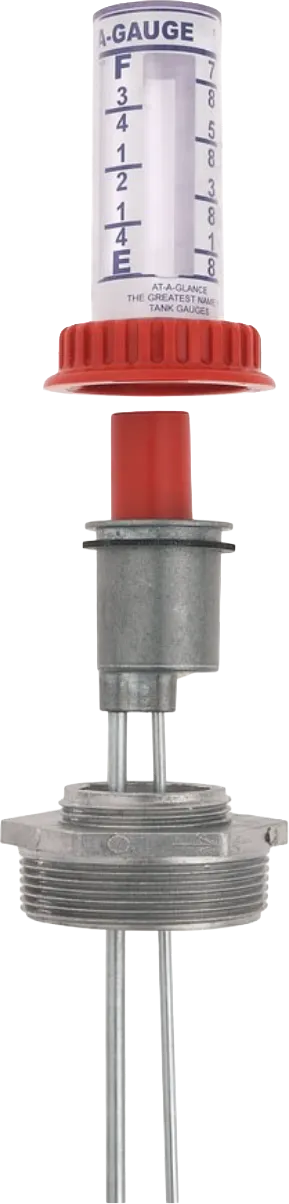
I try to sell the Therma gauge to most people. It is nearly as inexpensive as the At A Glance Gauge, but you have more control over your swing arm. Plus, this level gauge can be fitted with the most options.
What is the difference between the Type D At a Glance Level Gauge and the Type H Therma Level Gauge?
The Swing arm on the Type D Gauge is fixed. When you thread in the gauge, the swing arm spins inside the tank and will end up facing in a random direction. The swing arm on the Type H Gauge can be aimed in the exact direction you want it to swing, and when you thread the gauge in it does not spin inside the tank.
How long is the swing arm on a level gauge?
The arm is always half the depth of your tank.
How do I order a custom-size level gauge?
In order to get an accurate gauge for your tank, we take two measurements into consideration. First, we measure, in inches from top to bottom, what the distance is from empty to full, known as tank depth. Second, the distance from the full mark to the gauge fitting on top is also known as an extension length. Sometimes this measurement comes out to zero.
How do I prevent my tank gauge from getting damaged by the sun and weather?
Ordering upgraded options such as Solid Glass Tops and Gauge Guards will make your Krueger Gauge nearly impervious to weather, sun, and damage.
Can I repair just the top of my Tank Gauge, or do I need to replace the whole thing?
If your gauge still seems functional, you can replace just the top components by ordering the corresponding repair kit. Repair Kits are available for all gauge types and come in a variety of material options for added durability, which can be found in the Tank Gauge Accessories.
What is the recommended maintenance/testing for Krueger Leak Gauges?
Krueger Sentry provides a Leak Gauge Functionality / Calibration Testing Report with inspection procedures for inspectors/technicians. Please contact us with any questions.