
YOUR CART
- No products in the cart.
Subtotal:
$0.00
BEST SELLING PRODUCTS
Across industrial, commercial, and utility sectors, double-wall aboveground storage tanks (ASTs) remain a trusted way to store fuels, chemicals, and other regulated liquids. The second wall provides secondary containment — but containment only works as protection if someone knows when the first wall has failed. That knowledge lives in the interstitial space, the gap between the two walls.
A breach in the primary wall sends product into that space before it goes anywhere else. It is the earliest and clearest warning a double-wall tank can give. Without a way to see it, the first sign of failure can go unnoticed until the secondary wall is carrying the full load on its own.
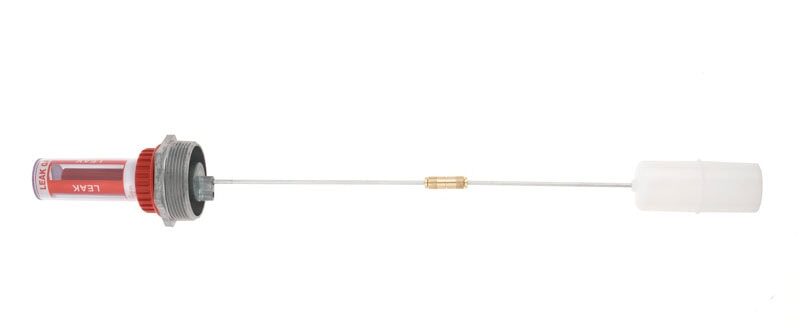
The Krueger Sentry Gauge Type K leak detection gauge makes that warning visible at the top of the tank — mechanically, with no power, no wiring, and nothing to calibrate.
In the United States, EPA release-detection requirements under 40 CFR Part 280 list interstitial monitoring among the approved methods for secondarily contained underground storage tank systems. Many state and local rules apply similar thinking to aboveground tanks, often alongside codes such as NFPA 30 where they have been adopted. The specifics vary by jurisdiction, but the principle does not: liquid in the interstitial space is a signal to act on, and it only helps if someone is watching for it.
When a primary wall leaks, product collects in the interstice. Left unaddressed, it can attack the secondary wall or find its way out through penetrations and fittings, turning a contained leak into a release — along with the cleanup, downtime, and regulatory exposure that follow.
Your takeaway: Put interstitial checks on a formal schedule. Frameworks governing underground systems commonly require interstitial monitors to be checked at least every 30 days, and a monthly check is sound practice on aboveground double-wall tanks whether or not a rule requires it. Confirm the requirement that applies to your tank with your state or local authority.
The Type K is a vertical, float-type leak monitor. It threads into a fitting at the top of the interstitial space, or into an external monitoring pipe, and its float sits at the bottom of that space.
That is the whole reading. The indicator is not calibrated to a level; it shows leak or no leak. There is no scale to interpret, which is the point — anyone walking past the tank can see the answer.
Because the gauge responds to any liquid collecting in the interstitial space, an indication should always be investigated rather than explained away. The job of the Type K is to tell you, early and unmistakably, that a space which should be dry no longer is.
Your takeaway: Confirm that the gauge’s materials suit the stored product and the service environment. Standard construction uses aluminum rods, an aluminum bushing, and a plastic calibration. Plastic and stainless steel alternatives are available, though custom materials carry smaller size limits.
A leak monitor that depends on power or a signal can stop reporting without announcing it. The Type K has no such failure mode: what it shows is what is in the interstitial space. For facilities handling regulated liquids, that makes it a straightforward component to build into an asset integrity program — and a straightforward one to defend in an inspection record.
Your takeaway: Add a visual check of every Type K to your routine tank inspection. Record the result each time, including “no indication,” and align the frequency with EPA requirements, applicable state AST rules, and codes such as NFPA 30 where adopted.
Contact us today to discuss your needs or request a quote. Our team is ready to help you find the best solutions for your storage systems.
View our certifications and contact our team for more details.



Contact our team of experts today. Fields marked with * are required.
"*" indicates required fields
Locate a Krueger Sentry Gauge Distributor







Comments are closed