
Easily Monitor Acetone Levels Without Opening Flammable Containers
Managing acetone storage safely and efficiently starts with knowing exactly how much you have — without exposing personnel to flammable vapors or risking a static ignition event. Traditional level checks require opening containers or manually sticking tanks, which increases flammability hazards, disrupts operations, and consumes valuable time.
At Krueger Sentry Gauge, we solve that problem.
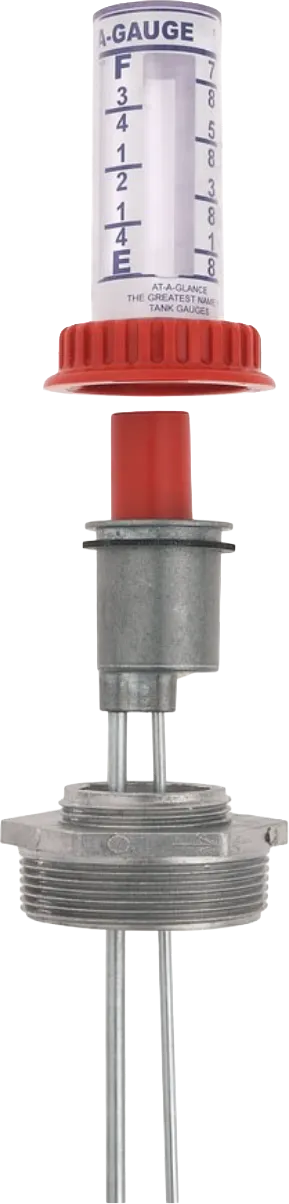
Our acetone tank level gauges are engineered to let you see acetone levels at a glance without opening containers, significantly reducing flammable exposure points and improving workplace safety. Designed and machined in the USA, these all-plastic mechanical gauges deliver dependable performance for both drum and tank storage applications.
Customized Level Gauge Solutions for Your Acetone Storage Needs
Krueger Sentry offers two dedicated stainless steel gauge families for acetone applications, covering both drums and bulk storage tanks.
These solutions are designed to provide:
- External level indication without opening flammable containers
- Durable stainless steel construction suitable for acetone service
- Simple, mechanical operation with clear visual indication
- American-made quality and consistent lead times
Acetone Barrel Level Gauges — BS3 Models
The BS3 stainless steel barrel level gauge is intended for acetone stored in standard 55-, 30-, and 15-gallon drums. The gauge installs into the drum using approved stainless steel fittings and provides a clear visual indication of fluid level without requiring the bung to be removed.
By allowing operators to check acetone levels without opening the container, BS3 gauges help reduce vapor exposure and support safer day-to-day inventory checks. Each gauge is factory calibrated for repeatable readings and built entirely from stainless steel to meet acetone service requirements.
Acetone Tank Level Gauges — HS3 Models
For bulk acetone storage, Krueger Sentry supplies HS3 stainless steel tank level gauges for aboveground tanks ranging from 6 inches to 12 feet in depth. These gauges can be configured to work with single-wall or double-wall tanks and can accommodate pipe risers or other mounting considerations.
HS3 gauges provide continuous, external level indication without requiring access to the tank interior. This allows operators to monitor acetone levels safely while maintaining consistent visibility across a wide range of tank sizes and configurations.
Why Stainless Steel Matters for Acetone Applications
Acetone service places specific demands on level measurement equipment. Stainless steel construction ensures compatibility with the chemical while maintaining long-term durability and predictable performance.
More importantly, external level indication helps facilities:
- Reduce exposure to flammable vapors
- Minimize ignition points during routine checks
- Support safer operating and inspection procedures
- Improve inventory awareness without disrupting operations
Krueger Sentry gauges are designed to integrate cleanly into existing storage practices while reducing the risks associated with manual level checks.
Why Choose Krueger Sentry for Acetone Level Monitoring
Reduce Fire and Exposure Risks
Opening acetone containers or manually checking tank levels introduces unnecessary exposure to flammable vapors. Krueger Sentry gauges allow operators to monitor acetone levels from outside the vapor space, reducing ignition risks and supporting safer operating procedures.
Built for Industrial Environments
These mechanical level gauges are designed for durability and clarity in demanding industrial settings. Unlike simple sight tubes that can fog, discolor, or fail, Krueger Sentry gauges provide reliable, easy-to-read level indication with minimal maintenance requirements.
Made in America
Every acetone level gauge is machined and assembled in the United States, supporting consistent quality, dependable lead times, and compliance with Buy American preferences where required.
Optional Accessories to Enhance Safety and Visibility
Krueger Sentry also offers optional accessories to further improve monitoring and safety, including:
Audible alarms to notify operators when acetone reaches critical levels
LED remote indicators for viewing tank levels from control rooms or workstations
Protective gauge guards to shield instruments from impact and environmental exposure
Simple, Stress-Free Acetone Level Monitoring in Three Steps
First, customize your gauge by selecting tank depth, connection size, and any double-wall or riser considerations, either online or with help from our applications team.
Second, review a confirmation drawing to verify dimensions and configuration before production.
Third, install the gauge and begin monitoring acetone levels safely and reliably.
Ready to Improve Acetone Storage Safety and Efficiency?
Contact Krueger Sentry Gauge to discuss a customized acetone level gauge solution and eliminate hazardous manual level checks from your facility.
We also provide level gauge solutions for a wide range of other chemical storage applications, including bleach, hydrochloric acid (HCl), sulphuric acid, sodium hydroxide, and other commonly stored industrial chemicals.
Frequently Asked Questions
Got questions? Get answers instantly by browsing our FAQs below, chatting with our AI assistant, or reaching out to our team directly.
What do we use as a part number?
At Krueger Sentry, we don’t use classic part numbers. Everything is description-based. Refer to your product’s Spec Page (materials options) and the Order Info (tank measurements) page for more information. Example Part Number: – H-2-48 + 12 w/glass (H signifies the type of gauge, 2 is the size opening, 48 is the tank depth, 12 is the extension, and everything after that is the options you want to be included.
Which liquid level monitor is the right choice for me?
When choosing a liquid level gauge, different factors can change which sight gauge is best for you. The basic factors that motivate people to buy each type of gauge are as follows.
- Economical sight gauge- At-A-Glance Direct Reading
- Versatile sight gauge- Therma Gauge
- Small tank monitor, under 12 inches – The L Gauge
- Standard Barrel Level Gauges – Barrel Gauge
- Up to 12 feet of mechanical remote capability – Remote Reading Gauge
- Durability – GFK Gauge – you can achieve this durability by ordering a therma gauge with a gauge guard as well.
How do I find or locate a Krueger Sentry Gauge distributor?
Search our Preferred Distributor Page. Don’t see a distributor you want to use? Call me. Lee Geurts: 920-434-8860 ext 204
Which sight gauge do you recommend most often to your customers?
I try to sell the Therma gauge to most people. It is nearly as inexpensive as the At A Glance Gauge, but you have more control over your swing arm. Plus, this level gauge can be fitted with the most options.
What is the difference between the Type D At a Glance Level Gauge and the Type H Therma Level Gauge?
The Swing arm on the Type D Gauge is fixed. When you thread in the gauge, the swing arm spins inside the tank and will end up facing in a random direction. The swing arm on the Type H Gauge can be aimed in the exact direction you want it to swing, and when you thread the gauge in it does not spin inside the tank.
How long is the swing arm on a level gauge?
The arm is always half the depth of your tank.
How do I order a custom-size level gauge?
In order to get an accurate gauge for your tank, we take two measurements into consideration. First, we measure, in inches from top to bottom, what the distance is from empty to full, known as tank depth. Second, the distance from the full mark to the gauge fitting on top is also known as an extension length. Sometimes this measurement comes out to zero.
How do I prevent my tank gauge from getting damaged by the sun and weather?
Ordering upgraded options such as Solid Glass Tops and Gauge Guards will make your Krueger Gauge nearly impervious to weather, sun, and damage.
Can I repair just the top of my Tank Gauge, or do I need to replace the whole thing?
If your gauge still seems functional, you can replace just the top components by ordering the corresponding repair kit. Repair Kits are available for all gauge types and come in a variety of material options for added durability, which can be found in the Tank Gauge Accessories.
What is the recommended maintenance/testing for Krueger Leak Gauges?
Krueger Sentry provides a Leak Gauge Functionality / Calibration Testing Report with inspection procedures for inspectors/technicians. Please contact us with any questions.